Hi! You can call me Anne,
Welcome to my Academic Journey 2025-2026
-
To me, anthropology represents...
creating space for and taking into account various perspectives. I began my university career in the pre-master’s programme in Cultural Anthropology in 2024 with the goal of being able to examine complex issues in the world without letting the noise of my emotions and opinions cloud my perspective. Now, after two years of study, excluding a gap year in between, I am convinced that I can do this. To me, anthropology now means that sensitivity, reflection, and ethical considerations are essential when delving deeply into a subject.
Before taking this academic step, I completed the more practically oriented Business Innovation programme, something completely different, in other words. But not entirely; that has more to do with my personal growth than with the structure of the programme itself. My passion for social research actually began there, when I investigated working conditions in the clothing industry. It opened my eyes, and from that moment on, the injustices in the world became something I couldn’t ignore for a long time. I even kept a list on my phone for moments when these topics became too heavy for me; it helped me return to a more positive mental state.
There were certainly a number of courses in Cultural Anthropology and Sustainable Citizenship in which a great deal of negativity was sometimes presented. I won’t deny that. However, these courses were taught by emotionally intelligent instructors who demonstrated, and explained, that having hope can, in itself, be a rebellious act. They also introduced us to people who had put this idea into practice.
This might still sound somewhat vague, but for me, the learning curve was incredibly steep, and I navigated it largely through the extensive writing required in this programme. The topic I delved into was the sheltering of Ukrainian residents in municipalities across the Netherlands, focusing specifically on one municipality. Through this experience, I discovered how investigating one specific issue through an anthropological lens can lead to a broader understanding of the contexts surrounding it.
Anthropology has given me the tools to unravel this complex case and its many competing interests. I achieved this in part through participant observation, active listening, and asking follow-up questions in the moment, and then by doing everything in my power to accurately and representatively put my findings down on paper.

Assignments
Here you'll find my personal development in the form of assignments.
Meetings
Here you find an oversight of all the insights we gathered as a group

Pitch
Three years ago, when I started my pre-master's in Cultural Anthropology, I thought I knew exactly where I was heading. My dream was to work on issues surrounding the clothing industry, particularly the inequalities within global supply chains and the fight against fast fashion.
During my studies, I had the opportunity to interview the CEO of a research organisation working between India and the Netherlands—a position I once considered my dream job. But that conversation made me realise something important: my strengths do not primarily lie in producing academic articles from behind a desk.
I have discovered that I thrive when I can place myself in the middle of a situation, when I can work closely with people, understand their experiences, and help translate complex issues into something meaningful and actionable.
That realisation led me to choose the migration track and redirect my focus to the public sector. Through my thesis on the sheltering of Ukrainian residents in a Dutch municipality, I learned how complex social issues are shaped by many different interests, perspectives, and power dynamics. It also showed me something about myself: I want to understand people and help others understand one another.
Today, I am looking for a project, a possibility, or a place where I can continue learning and contribute in a practical way. As long as it allows me to gain experience in the field of migration and social inclusion.
I don't have every step of my future planned out, and I think that is okay. I would like to leave you guys with a quote I learned to life by from Hermann Hesse his book Siddhartha. He writes about a river that is constantly flowing and changing, yet somehow remains the same.
I see my own journey in that metaphor. My direction has changed, but the underlying motivation has always remained the same: a strong sense of justice and a desire to contribute to a society in which people feel that they belong.
I think greatness will happen for us when we stop resisting the flow of life and learn to trust that our experiences, our doubts, and our aspirations all belong to the same river.
For now, I am learning to trust the river and to see where its current takes me next.
CV
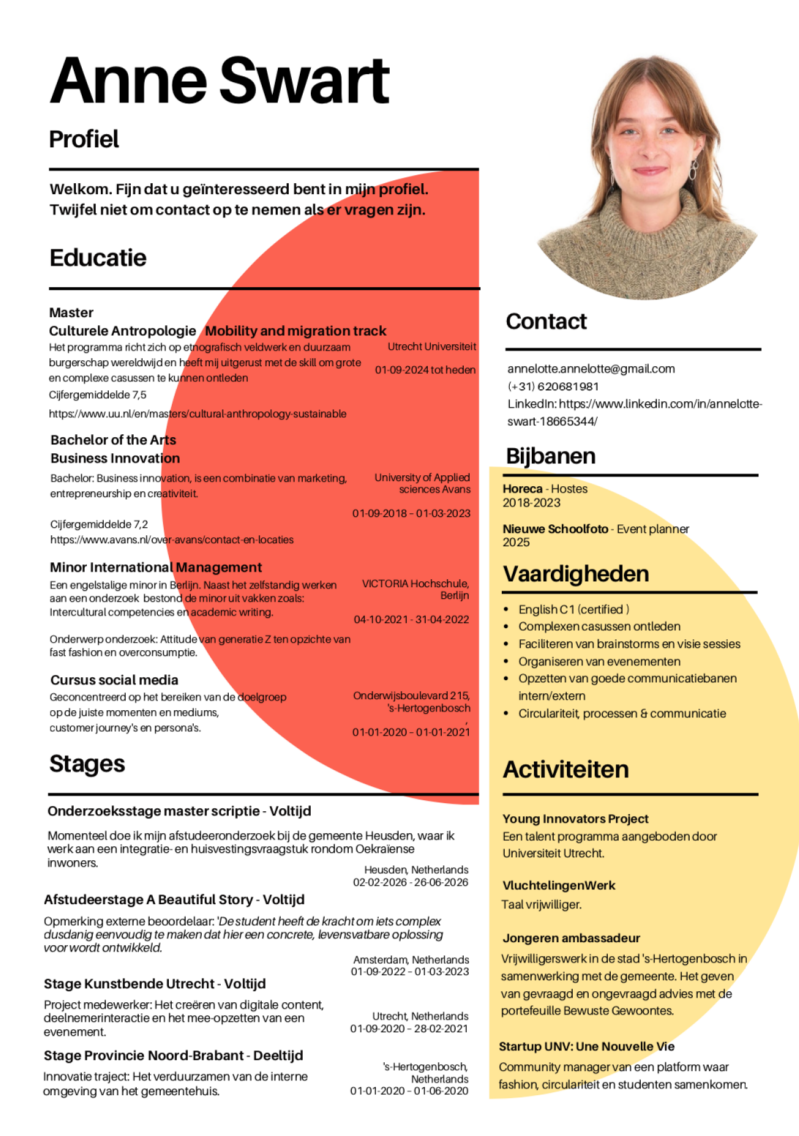
Skills
Qualitative Research & Ethnographic Methods
I am trained in qualitative and ethnographic research methods, including participant observation, conducting in-depth interviews, and contextual analysis. These methods allow me to gain a nuanced understanding of people's lived experiences and the social realities in which they are embedded.
Critical and Systems Thinking
I am able to analyse complex social issues by looking beyond individual cases and examining the broader systems, structures, and power dynamics that shape them. This enables me to connect personal experiences to larger societal processes and identify opportunities for meaningful change.
Translating Complexity into Actionable Insights
One of my strengths is making complex issues understandable without oversimplifying them. I can synthesise qualitative findings and translate them into practical insights and recommendations that are relevant for policymakers, organisations, and communities.
Communication and Active Listening
Through interviews, fieldwork, and academic writing, I have developed strong communication skills. I actively listen, ask probing questions, and facilitate conversations in a way that allows people to feel heard while generating deeper understanding and meaningful dialogue.
Intercultural Competence and Empathy
Working with diverse groups has taught me to approach different perspectives with openness, sensitivity, and respect. I am comfortable navigating multicultural environments and building trust with people from various social and cultural backgrounds.
Reflexivity and Ethical Awareness
Anthropology has taught me the importance of critical self-reflection and ethical decision-making. I continuously reflect on my own assumptions, positionality, and responsibilities as a researcher and professional, particularly when working with vulnerable populations.
Adaptability and Working in Ambiguous Situations
Fieldwork and migration-related issues often involve uncertainty and rapidly changing circumstances. I have learned to remain flexible, work independently, and adapt to unfamiliar situations while maintaining focus and professionalism.
Stakeholder Engagement and Collaboration
I enjoy working with different stakeholders and understand that complex societal challenges require cooperation between multiple actors. I am skilled at building relationships, understanding different interests, and facilitating dialogue between groups with diverse perspectives and objectives.
Motivation Letter VluchtelingenWerk Nederland
Dear recipient,
I am excited to apply for the position of Integration Expertise Consultant at VluchtelingenWerk Nederland. At a time when the political and social debate on migration is in a state of flux, VluchtelingenWerk plays a vital role in supporting refugees as they navigate a complex and often overwhelming journey. This work appeals to me because it lies at the intersection of legal support, social engagement, and advocacy. For people arriving in the Netherlands after a traumatic migration experience, it is essential that they receive support in understanding the Dutch legal and social systems.
My motivation lies in analyzing complex issues to safeguard people’s interests, driven by a strong sense of justice and solidarity. Over the past year, I have immersed myself in this field during my thesis research on the Temporary Protection Directive (RTB) and the Distribution Act. In this research, I examined how municipal reception and integration policies are implemented at the local level and what impact this has on the future prospects of displaced persons and refugees.
During this research, I collaborated with VluchtelingenWerk in the context of the reception of Ukrainian displaced persons in the municipality of Heusden. Among other things, I delved into the development of the transition document for Ukrainian residents and the developments surrounding the Distribution Act. This gave me insight into how policies and regulations play out in practice and taught me to critically examine policy implementation and recognize signals from the field. In addition, I volunteered in language classes and activities for Ukrainian residents.
My academic background in cultural anthropology enables me to analyze integration issues from various perspectives. I look not only at policy and regulations but also at the underlying social and cultural dynamics that influence their implementation. This analytical perspective helps me translate signals from the field into well-founded insights. In doing so, I have developed a strong affinity for the law and actively delve into issues surrounding immigration law and integration policy.
Furthermore, I bring a practical and independent work ethic to the table, gained through my completed higher professional education (HBO) degree. Thanks to my work experience in areas such as event planning and customer service, I am accustomed to communicating clearly over the phone and via email, analyzing questions, and conveying information in a structured manner.
Because my thesis project is closely linked to the professional field, I see myself as an entry-level professional who is actively engaged with these issues. With my commitment to the field and my tireless perseverance, I hope to make a valuable contribution to the work of the Dutch Council for Refugees and to strengthening the position of refugees in the Netherlands.
I would be happy to further explain my motivation and background in a personal interview.
Kind regards,
Anne Swart

Final Reflection
Final Reflection and Future Perspectives
The Past – The Beginning of My Studies
Over the past few years at university, I have completely turned my direction upside down.
When I first sat in a U-shaped arrangement of tables in the (correct!) classroom at the university three years ago, I felt that I had a clear plan. I wanted to immerse myself in the underlying systems of the clothing value chain and the relationship between the Dutch and Bangladeshi markets. My goal was to eventually work through NGOs or other organisations and contribute to the fight against fast fashion.
In my mind, this work would involve being responsible for the personal cases of people who had managed to raise concerns about the working conditions in one of the many problematic factories in the industry. Together with a fellow student, who has since become both a graduate and a close friend, I explored the cotton industry in India and Bangladesh. Through one of her contacts, we were given the opportunity to interview someone who, at the time, had my dream job: the CEO of a research organisation operating between India and the Netherlands.
During the interview, we asked her about the path she had taken to get there. Besides being an inspiring and educational conversation, it also made me realise something important. If I wanted to pursue this particular career path, a large part of my work would consist of writing academic articles. Coming from a practical HBO background, I did not see this as my greatest strength.
From that moment onwards, I decided to broaden my horizon.
Fortunately, I was doing the pre-master's programme and was exposed to many other topics and perspectives. Combined with the year I spent working and travelling in between my studies, I came to realise where my strengths truly lie. I thrive when I can place myself in the middle of a situation—when the people I work with, and hope to reach and support, are close by and I can move alongside them.
This realisation made me understand that the public sector and consultancy are directions that suit me much better.
After choosing the Migration track within the programme, I felt an immediate connection with the issues being discussed and with the complexity that often accompanies them. Migration issues are rarely straightforward because they involve many different interests, perspectives, and power dynamics.
One of my strengths is my genuine desire to understand people and to help them understand one another. I enjoy making complicated issues accessible without oversimplifying them or losing their essence and importance. The strong sense of justice that I have carried with me since my teenage years feels at home in this field.
The Present – Developments That Helped Me Grow
This is where I find myself today: full of intrinsic motivation to dedicate myself to people and to the human need to belong somewhere.
What I am still figuring out is the place where I can best put this motivation into practice. Perhaps this description remains somewhat vague, but that is also because I intentionally keep my search broad. I want to remain open to opportunities and experiences that may further shape my professional identity.
The Future – What I Am Aiming For
At the moment, I have been in conversations with organisations such as VluchtelingenWerk Nederland, Refugee Company, and one local municipality. I am still uncertain about whether working for a municipality is the right fit for me. On the one hand, it means being directly in service of citizens and having the opportunity to make a tangible impact. On the other hand, it can also mean operating within the stagnating and highly politicised environment surrounding refugee sheltering in the Netherlands, where polarisation and social unrest increasingly manifest themselves.
What I am looking for is a project or an opportunity where I can continue learning and gain practical experience in the field.
I know that finding the right job is not something that happens overnight. I hear that from many people around me. And perhaps allowing myself some rest after this intense thesis marathon is not such a bad idea either.
What I do know, however, is that I now have a direction. I can rest and begin my search at the same time, as long as I remain honest and realistic in my expectations of myself.
As a final metaphor, I would like to borrow one from Hermann Hesse's Siddhartha. Siddhartha learns from the river, which is constantly flowing and changing, yet somehow always remains the same:
"The river is everywhere at the same time: at its source and at its mouth, at the waterfall, at the ferry, at the current, in the ocean and in the mountains, everywhere, and the present only exists for it, not the shadow of the past nor the shadow of the future."
For me, this quote captures what these past years have taught me. Time is, in many ways, an illusion. Everything is connected. Growth requires acceptance, and sometimes the most valuable thing we can do is stop searching so intensely and start listening.
I think greatness will happen for us when we stop resisting the flow of life and learn to trust that our experiences, our doubts, and our aspirations all belong to the same river.
Adres
Utrecht University
Contact
Annelotte Swart
0715832
Course
Academic Professionals
Date
01-06-2026
Maak jouw eigen website met JouwWeb