Oversight assignments
-
1
Personal Development Plan
2
Network Map
3
Coffee date
4
Ethical reflection
5
Skills, CV, Letter
6
What does anthropology mean to me?
Assignments
Click on the arrow to open the assignment
1 Personal development plan
My personal motivation for selecting the SCIM program is both practical and emotional. During my Applied Sciences studies (Business Innovation), I discovered that my passion lies in conducting social research. However, I was unable to demonstrate this in terms of specialization within my studies, which is why I chose the pre-master's program in Cultural Anthropology as a follow-up study. This allowed me to further develop this passion and to deepen my understanding of certain topics and theories and apply them. My prior field of study was much more focused on practice and gathering information through fieldwork. The emotional reason for choosing SCIM is that hearing someone's story is at the heart of what cultural anthropology means to me, and in which I hope to become systematically and ethically sufficient. This is what I consider to be the most important aspect of the program. So far, during the pre-master's program, I have already made progress in the field of academic writing, something that was a challenge for me and sometimes still is. Because my bachelor got me a diploma in the arts in the end and not much academic writing skills. But there is an upward trend in the learning curve I have made during the pre-master's program.
Since, in my opinion, the pre-master's program focused largely on the introduction and 101 of Anthropology and the knowledge required for it, I hope to gain more practical experience this year, independently. I am also excited to start my extra credit program within University Utrecht called Young Innovators Project. My interest in people in general is something that has always been a part of me. How I will systematically deal with this data input will be a point of focus.
The biggest challenges I have identified for myself so far is planning and my positioning in the debates within anthropology and probably also in my research later on. I would rather not be hypocritical, and sometimes my privileges make me feel even more strongly how unfair the world is, and this clouds my vision. I would like to learn more about what kind of practical and public anthropological work exists and draw inspiration from it for my research. It would be great to contribute to something or at least find a debate in which I can add a strong argument. To this end, I was looking at the public sector in combination with anthropology. I have never really planned more than six months ahead in my life, but I have been fantasizing of course. I know that I would like to join an organization whose vision I agree with.
My pitfall last year was the confusion about whether I was doing inductive or deductive research. For me, it is essential to have my plan and concepts well organized before I start the writing phase. To this end, I gathered a number of tips during the pre-master's program that I will use again this year. I will also share these tips with the group we are working with for this course. We all sat down together outside the campus in a non-professional environment to make it easier to build a relationship of trust. Together with the three other girls, we have made an overview for the entire coming academic year and when we want to get together to prepare the assignments and also support each other during the period when we will be doing fieldwork. We have planned an extra moment, online or in real life, in which we can guide each other through the challenges we will be facing. At the moment, I think I will appreciate having multiple perspectives on the state of things during the fieldwork period and help each other with positioning as well.
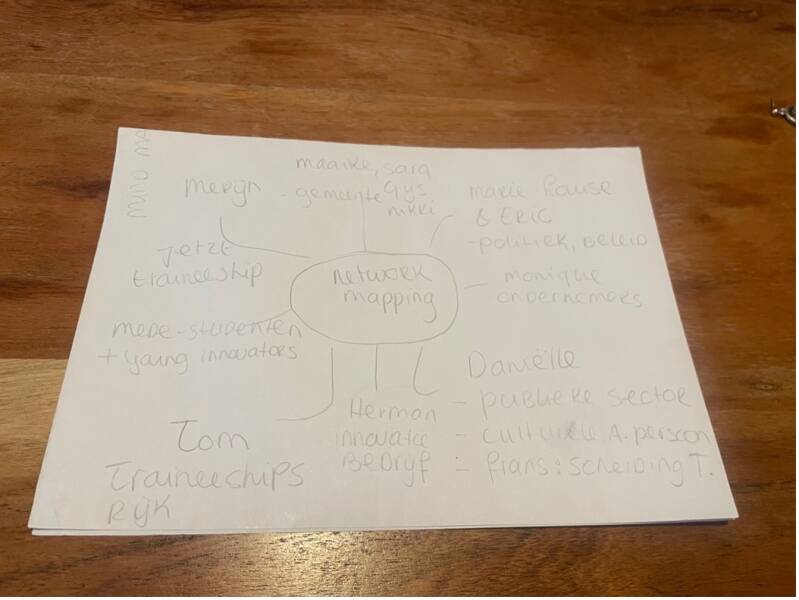
2 Network Map
*See below page
3 Coffee date
Coffee date with a Municipal Civil Servant
I had a coffee meeting with a civil servant who was directly involved in the Ukrainian reception case in a municipality. Our conversation gave me valuable insight into the realities of policymaking and implementation at the local level. It confirmed my interest in working on societal issues that require balancing different interests while staying close to the people affected by these decisions.
Coffee date with a Project Leader from a Consultancy Firm
I also spoke with a project leader who was carrying out a one-year assignment on Ukrainian reception through a consultancy bureau. This conversation showed me how consultants can contribute to complex social issues by bringing an outside perspective, structure, and practical solutions. It strengthened my interest in project-based work and consultancy within the public sector.
Coffee date with an Employee of Refugee Company
Through a chance encounter at a birthday party, I connected with someone working at Refugee Company. Our conversation gave me a better understanding of how organisations can create opportunities for newcomers by focusing on participation, belonging, and empowerment. It reinforced my motivation to work in a field where belonging and meaningful impact are central.
4 Ethical reflection
- Make the other person(s) feel comfortable is priority
- Mention when you want to ask something more invasive beforehand
- If you want to use quotes, dubble check with the interlocutor
- Trust intuition and follow random straints of information when they come up
- Be aware of the wall that is created through temporal presence, be considered of this in relationships.
Code of conduct
Participation in this research is voluntary and based on informed consent, understood as an ongoing process rather than a one-time agreement, following the guidelines of the American Anthropological Association. Participants are informed about the purpose of the research, the use of data, and their right to withdraw at any moment without consequences. Information letters are available in Dutch and Ukrainian, while consent forms are provided in Dutch and English. Where written consent is not possible or appropriate, verbal consent may be obtained and documented.
The privacy and well-being of participants remain central throughout the research. Pseudonyms are used in field notes, transcripts, and the final thesis, while identifiable details may be altered or omitted to prevent recognition within the local context of Heusden. Interviews take place in locations chosen by participants to ensure comfort and safety. Audio recordings are used for accurate transcription and analysis and are securely stored on password-protected devices and university servers until the thesis is completed, after which they are deleted. Participants are never pressured to discuss sensitive subjects, and potentially invasive questions will be communicated beforehand. Direct quotes will only be used after double-checking with the interlocutor.
As a white master’s student in Anthropology with a relatively secure social and legal position, I recognize that my background influences both access to the field and relationships with participants. This requires continuous reflexivity regarding representation, interpretation, and power inequalities within the research process. Trust and rapport are built through long-term engagement and volunteering within the organizations. At the same time, I remain aware of the temporal nature of fieldwork and the relational distance that may emerge once research ends. Conversations with Ukrainian refugees during organized activities are not treated as research data unless explicit consent is obtained.
Ethics are approached as an ongoing and relational process. Alongside formal ethical procedures, I remain attentive to intuition, unexpected strands of information, and emerging ethical dilemmas during fieldwork. The research process is continuously evaluated in dialogue with supervisors and peers to ensure the integrity of both participants and the research itself.
5 Skills, CV, Letter
* See Home page
6 What does anthropology mean to me?
Final Reflection and Future Perspectives
The Past – The Beginning of My Studies
Over the past few years at university, I have completely turned my direction upside down.
When I first sat in a U-shaped arrangement of tables in the (correct!) classroom at the university three years ago, I felt that I had a clear plan. I wanted to immerse myself in the underlying systems of the clothing value chain and the relationship between the Dutch and Bangladeshi markets. My goal was to eventually work through NGOs or other organisations and contribute to the fight against fast fashion.
In my mind, this work would involve being responsible for the personal cases of people who had managed to raise concerns about the working conditions in one of the many problematic factories in the industry. Together with a fellow student, who has since become both a graduate and a close friend, I explored the cotton industry in India and Bangladesh. Through one of her contacts, we were given the opportunity to interview someone who, at the time, had my dream job: the CEO of a research organisation operating between India and the Netherlands.
During the interview, we asked her about the path she had taken to get there. Besides being an inspiring and educational conversation, it also made me realise something important. If I wanted to pursue this particular career path, a large part of my work would consist of writing academic articles. Coming from a practical HBO background, I did not see this as my greatest strength.
From that moment onwards, I decided to broaden my horizon.
Fortunately, I was doing the pre-master's programme and was exposed to many other topics and perspectives. Combined with the year I spent working and travelling in between my studies, I came to realise where my strengths truly lie. I thrive when I can place myself in the middle of a situation—when the people I work with, and hope to reach and support, are close by and I can move alongside them.
This realisation made me understand that the public sector and consultancy are directions that suit me much better.
After choosing the Migration track within the programme, I felt an immediate connection with the issues being discussed and with the complexity that often accompanies them. Migration issues are rarely straightforward because they involve many different interests, perspectives, and power dynamics.
One of my strengths is my genuine desire to understand people and to help them understand one another. I enjoy making complicated issues accessible without oversimplifying them or losing their essence and importance. The strong sense of justice that I have carried with me since my teenage years feels at home in this field.
The Present – Developments That Helped Me Grow
This is where I find myself today: full of intrinsic motivation to dedicate myself to people and to the human need to belong somewhere.
What I am still figuring out is the place where I can best put this motivation into practice. Perhaps this description remains somewhat vague, but that is also because I intentionally keep my search broad. I want to remain open to opportunities and experiences that may further shape my professional identity.
The Future – What I Am Aiming For
At the moment, I have been in conversations with organisations such as VluchtelingenWerk Nederland, Refugee Company, and one local municipality. I am still uncertain about whether working for a municipality is the right fit for me. On the one hand, it means being directly in service of citizens and having the opportunity to make a tangible impact. On the other hand, it can also mean operating within the stagnating and highly politicised environment surrounding refugee sheltering in the Netherlands, where polarisation and social unrest increasingly manifest themselves.
What I am looking for is a project or an opportunity where I can continue learning and gain practical experience in the field.
I know that finding the right job is not something that happens overnight. I hear that from many people around me. And perhaps allowing myself some rest after this intense thesis marathon is not such a bad idea either.
What I do know, however, is that I now have a direction. I can rest and begin my search at the same time, as long as I remain honest and realistic in my expectations of myself.
As a final metaphor, I would like to borrow one from Hermann Hesse's Siddhartha. Siddhartha learns from the river, which is constantly flowing and changing, yet somehow always remains the same:
"The river is everywhere at the same time: at its source and at its mouth, at the waterfall, at the ferry, at the current, in the ocean and in the mountains, everywhere, and the present only exists for it, not the shadow of the past nor the shadow of the future."
For me, this quote captures what these past years have taught me. Time is, in many ways, an illusion. Everything is connected. Growth requires acceptance, and sometimes the most valuable thing we can do is stop searching so intensely and start listening.
I think greatness will happen for us when we stop resisting the flow of life and learn to trust that our experiences, our doubts, and our aspirations all belong to the same river.
Network map
Maak jouw eigen website met JouwWeb